Digital Marketing for Doctors in India: The 2026 Ethical Blueprint for Practice Growth
How modern doctors, clinic owners, and hospital directors in India build high-trust digital authority, capture high-intent local patients, and turn online inquiries into confirmed OPD footfall without violating medical ethics.
Jaydeep Kataria
Healthcare Growth & SEO Lead, Epsilon Technology
Epsilon Healthcare Framework
Visibility → Trust → Patient Enquiry → Follow-up → Appointment
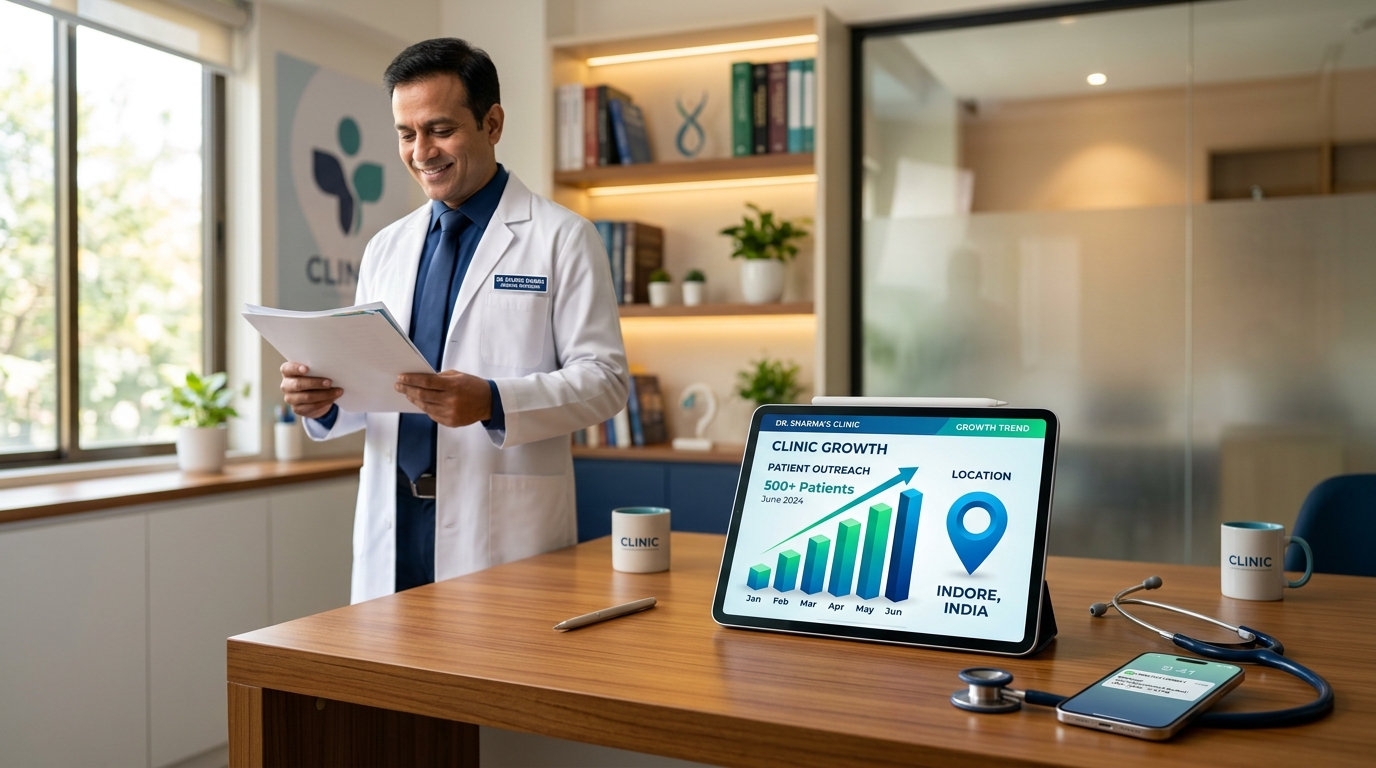
Over 78% of urban and tier-2 patients in India now cross-reference doctor recommendations on Google Search, Google Maps, and video platforms before setting foot in a clinic. Traditional word-of-mouth is no longer the sole growth driver—it has become a digital verification step. Doctors who build structured digital visibility dominate OPD consultations, while those relying strictly on legacy reputation face declining new-patient volumes.
1. The State of Medical Practice Marketing in India (2026)
The Indian healthcare landscape has entered a hyper-competitive era. Multi-specialty hospital chains with eight-figure advertising budgets aggressively compete for high-yield elective and non-elective specialties such as Orthopedic Joint Replacement, IVF & Fertility, Dermatology & Cosmetology, and Pediatrics.
At the same time, independent clinics and specialized practitioners face two critical challenges:
- Third-Party Aggregator Rent-Seeking: Platforms like Practo and Justdial charge steep listing fees while positioning competitor ads directly on the doctor's profile page.
- Commoditization by Aggressive Marketers: Generic marketing agencies flood social feeds with discounted health packages, destroying doctor-patient trust and attracting low-intent, price-sensitive shoppers.
To establish enduring clinical independence, Indian doctors require an owned asset ecosystem: a high-speed website, an optimized Google Business Profile, authentic clinical educational content, and an automated patient inquiry follow-up pipeline.
The Epsilon Doctor Growth System™
The proprietary 5-stage architecture turning digital searchers into loyal patients.
Visibility
Ranking in the Google 3-Pack Map Pack, conversational AI answers, and geo-targeted search queries within a 5–15 km radius.
Trust
Ethical video education, real patient testimonials, verified credentials, and clear answers to pre-visit anxieties.
Patient Enquiry
Frictionless 1-click WhatsApp booking, click-to-call mobile triggers, and clear OPD schedule transparency.
Follow-up
Instant automated WhatsApp acknowledgment within 60 seconds, receptionist triage scripts, and pre-consultation guidance.
Appointment
Confirmed calendar slot, automated location pins, parking directions, and post-consultation review collection.
2. NMC Regulations & Ethical Healthcare Marketing in India
The National Medical Commission (Registered Medical Practitioner Conduct) Regulations set clear boundaries for medical advertising. Failing to adhere to these standards puts a doctor's medical registration at risk.
- ✓ Factual doctor qualifications (MBBS, MS, DNB, MCh)
- ✓ Accurate clinic address, phone, and OPD consultation hours
- ✓ Patient educational videos explaining symptoms & care
- ✓ Verified Google Business Profile & map directions
- ✓ Transparent procedure details and medical FAQs
- ✕ "100% Guaranteed Cure" or absolute outcome claims
- ✕ Self-laudatory superlatives ("Best / #1 Doctor in City")
- ✕ Misleading, edited before-and-after photo manipulations
- ✕ Fee discounting banners ("50% Off Knee Surgery Today")
- ✕ Paying commission or kickbacks for patient referrals
3. The 4 High-ROI Digital Pillars for Indian Clinics
Pillar A: Google Business Profile (GBP) & Local Map Pack Dominance
When an anxious mother searches for "pediatrician near me" at 9 PM, she selects from the top three Google Map results. Dominating the local 3-Pack requires:
- Exact Category Architecture: Setting primary category as Pediatrician and secondary categories like Children's Hospital, Pediatric Clinic.
- Review Velocity & Keyword-Rich Responses: Continuously collecting authentic patient feedback mentioning specific conditions treated (e.g., "Dr. Shah handled our newborn vaccination smoothly").
- Weekly Clinical Geo-Updates: Publishing photos of clinic sanitization, diagnostic facilities, and health tips with localized geotags.
Pillar B: High-Speed, Conversion-Engine Medical Website
Most healthcare websites in India fail because they act as digital brochures rather than conversion engines. A patient-centric website must load in under 1.5 seconds on 4G/5G mobile networks and feature:
- Specialist credentials and medical association badges displayed above the fold.
- Sticky 1-click WhatsApp and call buttons accessible on mobile screens.
- Comprehensive dedicated landing pages for specific symptoms, treatments, and procedures with structured Schema.org markup.
Pillar C: Educational Doctor Video Branding (Reels & YouTube)
Video is the fastest vehicle to build patient trust in India. A 45-second Reel addressing common patient fears (e.g., "Is robotic knee replacement safe for senior citizens?") establishes clinical empathy before the patient ever visits the clinic.
Pillar D: WhatsApp Business API Automation & Front-Desk Triage
In India, WhatsApp is the operating system for daily life. Integrating the WhatsApp Business API allows clinics to:
- Instantly greet inbound inquiries 24/7 with doctor OPD timings.
- Automate appointment slot confirmation and send Google Maps location pins.
- Deliver pre-procedure fasting guidelines and automated post-consultation review requests.
4. Healthcare Digital Marketing Economics: CAC vs Patient Lifetime Value
Unlike ecommerce where transaction values are low, medical specialty practice economics benefit from high Patient Lifetime Value (LTV) and surgical case values.
| Medical Specialty | Target Search Keywords | Avg. Patient Value | Estimated CAC | Estimated ROI |
|---|---|---|---|---|
| Orthopedic Surgery | Knee replacement, arthroscopy, spine specialist | ₹1,20,000 – ₹2,50,000 | ₹1,800 – ₹3,500 | 35x – 60x |
| IVF & Fertility | IVF center near me, ICSI treatment cost | ₹1,50,000 – ₹3,00,000 | ₹2,500 – ₹4,800 | 30x – 55x |
| Dermatology / Cosmetology | Acne scar laser, PRP hair treatment, hydrafacial | ₹15,000 – ₹50,000 | ₹600 – ₹1,400 | 12x – 25x |
| Pediatric OPD Clinic | Child specialist, baby vaccination center | ₹12,000 (Annual LTV) | ₹300 – ₹650 | 18x – 30x |
*Figures are representative estimates based on typical private practice OPD and elective procedure economics in Tier-1 and Tier-2 Indian cities. Individual practice results vary by location, facility accreditation, and consultation charges.
5. 3 Dangerous Traps Indian Doctors Must Avoid
Trap 1: Outsourcing to Low-Cost "Poster-Making" Agencies
Paying ₹5,000/month for an agency to post generic stock graphics ("Happy World Health Day!") generates zero patient inquiries. Patients book doctors because of clinical authority, verified reviews, and location proximity—not generic holiday greeting graphics.
Trap 2: Ignoring Front-Desk Response Time
A study of clinical lead conversion in India reveals that patient inquiries contacted within 5 minutes are 7 times more likely to convert into an OPD visit compared to those contacted after 1 hour. If your clinic receptionist only checks WhatsApp at the end of the day, 80% of your advertising budget is wasted.
Trap 3: Buying Fake Google Reviews
Google’s spam algorithms aggressively detect and penalize profiles with sudden influxes of unnatural reviews. Account suspensions can permanently erase a clinic’s local search visibility. The only sustainable strategy is implementing systematic review request workflows for genuine discharged patients.
6. The 90-Day Implementation Roadmap for Doctors
Here is how Epsilon Technology rolls out the Doctor Growth System for independent clinics and hospitals across India:
- Month 1 (Foundation & Local SEO): Comprehensive technical audit, Google Business Profile restructuring, medical schema deployment, and front-desk WhatsApp CRM integration.
- Month 2 (Content & Authority Engine): Publishing high-intent specialty service pages, filming 8–12 educational patient Q&A reels, and initiating review velocity sequences.
- Month 3 (Conversion Scaling & AI Visibility): Optimizing for conversational AI queries (ChatGPT/Perplexity/Gemini), scaling targeted local search ads for high-yield procedures, and reviewing monthly OPD growth metrics.
Get Your Free Digital Visibility Diagnosis
Discover where your clinic is losing patients to competitors on Google Maps, AI search, and WhatsApp. Receive an objective 15-point audit within 24 hours.
Frequently Asked Questions
Is digital marketing legal and ethical for doctors in India under NMC guidelines?
Yes, when conducted ethically. The National Medical Commission (NMC) regulations allow doctors and healthcare institutions to provide factual, educational information regarding their qualifications, specialties, clinic hours, location, and medical conditions they treat. However, making sensational claims, guaranteeing cure rates, publishing misleading before-and-after photos, or disparaging peers is strictly prohibited. Ethical medical marketing focuses on patient education, reputation building, and accessibility.
How long does it take for a clinic to see measurable patient inquiries from digital marketing?
Typically, local search optimization (Google Business Profile) and targeted search campaigns generate initial inquiries within 30 to 45 days. Organic topical SEO, doctor personal branding, and algorithmic trust require 3 to 6 months of consistent execution to deliver compounding, self-sustaining OPD footfall.
Why do most doctor marketing campaigns produce inquiries but low show-up rates?
The primary point of failure in 85% of Indian clinics is the front-desk follow-up pipeline. If a patient inquires via a digital channel and does not receive an immediate response (within 5 minutes) or a structured WhatsApp confirmation with location pins, preparation instructions, and consulting hours, they quickly book with a competing clinic. Bridging the gap requires automated WhatsApp triage and receptionist lead training.
What is the expected budget for digital marketing for an independent doctor or clinic in India?
A single-specialty clinic typically invests ₹20,000 to ₹50,000 per month for organic local SEO, reputation management, and content creation. Multi-specialty hospitals or competitive metro practices targeting high-value surgical procedures (orthopedics, IVF, hair transplant, bariatric) allocate ₹60,000 to ₹1,50,000+ per month across search ads, automated CRM funnels, and video production.
How does AI search (ChatGPT, Perplexity, Google AI Overviews) change how patients find doctors in India?
Patients are shifting from searching 2-word keywords like 'best pediatrician' to complex conversational prompts like 'Which pediatrician in Ahmedabad has experience with neonatal jaundice and evening OPD?'. AI models extract verified entity data, structured medical schema, and consistent cross-platform citations. Practicing Generative Engine Optimization (GEO) ensures your practice is cited by AI answers.
Authored by Jaydeep Kataria
Healthcare Digital Strategist | Founder, Epsilon Technology
Specializing in building ethical, high-conversion patient acquisition infrastructure, local search dominance, and AI visibility systems for medical clinics and hospitals across India.