
SEO for Doctors: The Complete Technical & Local Guide for 2026
How healthcare practices build high-trust organic search visibility, implement structured medical schema, master Google's YMYL standards, and capture high-intent patients looking for care.
Jaydeep Kataria
Lead SEO Architect | Epsilon Technology
Epsilon Technical Medical SEO
YMYL Compliance • Medical Schema • E-E-A-T Signals • Google 3-Pack
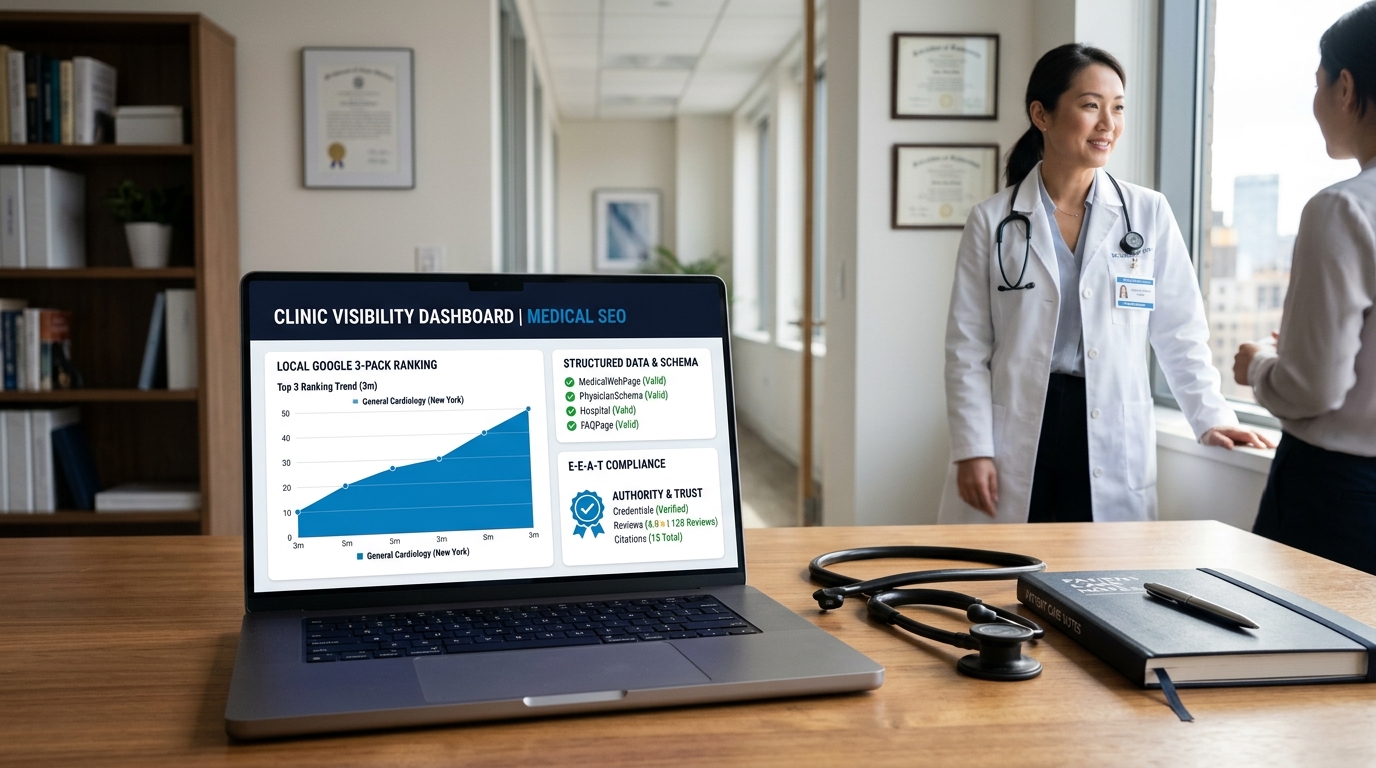
Medical SEO is distinct from any other commercial industry. Google evaluates healthcare websites under its most demanding algorithmic standards (YMYL & E-E-A-T). Ranking your clinic requires a 4-layer technical stack: Core Web Vitals & Speed, Physician Entity Authority, Structured Medical Schema Markup, and Hyper-Local Map Pack Optimization.
1. Google's YMYL & E-E-A-T Standards for Healthcare
In 2026, Google's Quality Rater Guidelines emphasize that medical content must demonstrate verifiable clinical authority. Anonymous blog posts signed by "Admin" or "Staff" are treated as low-quality.
Every medical page on your website must incorporate:
- Named Medical Author & Reviewer: Clear attribution to the licensed physician (e.g., "Written and medically reviewed by Dr. Rajesh Patel, MS Orthopedics, Fellowship in Joint Replacement").
- Clinical Citations: Links to peer-reviewed studies (PubMed, NCBI, Indian Council of Medical Research) when citing statistics or treatment efficacy.
- Date Stamps: Prominently displayed "Date Published" and "Last Medically Reviewed" dates to signify current medical standard of care.
2. The 3 Types of Patient Search Intent
To capture patients across their journey, your website must target three distinct intent levels:
Symptom Exploration (Top of Funnel)
Patient notices an issue and queries symptoms (e.g., "Sharp pain in right knee when climbing stairs").
Asset: Informative symptom checklist with doctor commentaryTreatment Evaluation (Middle of Funnel)
Patient has been diagnosed and evaluates treatment modalities (e.g., "Robotic knee replacement vs conventional knee surgery recovery time").
Asset: Procedure breakdown & recovery timeline comparisonProvider Selection (Bottom of Funnel - High Conversion)
Patient is ready to book a consultation (e.g., "Orthopedic surgeon in Bodakdev Ahmedabad OPD timings").
Asset: Doctor bio page, 1-click WhatsApp booking & Google Map embed3. Structured Medical Schema Implementation
Schema markup bridges your website and search engine knowledge graphs. Here is the canonical JSON-LD structure Epsilon deploys for physician clinics:
{
  "@context": "https://schema.org",
  "@type": "MedicalClinic",
  "name": "Apex Orthopedic & Joint Care Clinic",
  "image": "https://example.com/clinic-exterior.webp",
  "address": {
    "@type": "PostalAddress",
    "streetAddress": "304, Titanium Square, SG Highway",
    "addressLocality": "Ahmedabad",
    "addressRegion": "Gujarat",
    "postalCode": "380054",
    "addressCountry": "IN"
  },
  "geo": {
    "@type": "GeoCoordinates",
    "latitude": "23.0489",
    "longitude": "72.5186"
  },
  "telephone": "+91-98765-43210",
  "medicalSpecialty": "OrthopedicSurgery",
  "availableService": [
    {
      "@type": "MedicalProcedure",
      "name": "Robotic Total Knee Replacement",
      "procedureType": "SurgicalProcedure"
    }
  ],
  "physician": {
    "@type": "Physician",
    "name": "Dr. Rajesh Patel",
    "medicalSpecialty": "OrthopedicSurgery",
    "alumniOf": "B.J. Medical College, Ahmedabad"
  }
}
4. Core Web Vitals & Mobile-First Healthcare Experience
Over 82% of patient searches in India occur on mobile devices. A website that takes longer than 2.5 seconds to load or shifts layout unexpectedly causes immediate bounce.
Key technical optimizations required:
- Largest Contentful Paint (LCP) < 1.5s: Next-gen WebP/AVIF images, modern edge CDN caching, and lightweight CSS.
- Zero Layout Shifts (CLS = 0): Explicit image dimensions and pre-allocated mobile viewport blocks.
- Interaction to Next Paint (INP) < 100ms: Eliminating heavy third-party tracking scripts that block mobile UI responsiveness.
For an exhaustive technical audit framework, consult our Doctor Website SEO Checklist (25-Point Health Index).
5. Building Topical Authority Clusters for Clinics
Google no longer ranks standalone pages. It rewards websites that demonstrate comprehensive topical mastery. If you are an Orthopedic Specialist, your content architecture should branch into dedicated sub-clusters:
- Pillar Page: Knee Pain & Joint Replacement Surgery (Comprehensive Guide)
- Cluster 1: Robotic vs Traditional Knee Surgery: Pros, Cons & Recovery
- Cluster 2: Non-Surgical Treatment for Grade 2 Knee Osteoarthritis
- Cluster 3: Knee Replacement Cost & Cashless Insurance Guide in Ahmedabad
- Cluster 4: Post-Operative Physiotherapy & Home Care Roadmap
Get Your Free Digital Visibility Diagnosis
Discover technical SEO flaws, missing schema markup, and keyword ranking opportunities for your clinic website.
Frequently Asked Questions
Why is SEO different and stricter for doctors compared to standard businesses?
Healthcare falls under Google's strict 'Your Money Your Life' (YMYL) guidelines. Because medical information directly impacts human health and life decisions, Google's search algorithms demand the highest levels of Experience, Expertise, Authoritativeness, and Trustworthiness (E-E-A-T). Generic, unverified, or AI-generated medical content without qualified physician authorship is systematically demoted.
What is Medical Schema markup and why does every clinic website need it?
Medical Schema (using Schema.org types like MedicalClinic, Physician, MedicalProcedure, and MedicalCondition) is structured machine-readable code that tells search crawlers and AI engines exact clinical facts about your practice—such as doctor registration numbers, board certifications, medical conditions treated, accepting insurance, and clinic address. This enables Google and AI answer engines to accurately cite your clinic in search results.
How long does it take for a medical practice to rank on page 1 of Google?
Local map rankings (Google Business Profile) typically improve within 45 to 60 days. Organic rankings for competitive procedure keywords (e.g., 'laparoscopic hernia surgery cost' or 'pediatric dermatologist') require 3 to 6 months of topical authority building, fast Core Web Vitals optimization, and patient review velocity.
Can doctors rank nationally or should SEO focus strictly on local search?
Unless offering specialized telemedicine or rare super-specialty surgery attracting medical tourists, 90% of a clinic's SEO resources should focus on hyper-local and regional search (a 5 to 30 km radius). Ranking #1 in your local metropolitan or district catchment area delivers infinitely higher OPD conversion than ranking nationally for broad informational queries.
Authored by Jaydeep Kataria
Lead Technical SEO Architect | Epsilon Technology
Pioneering high-speed Next.js healthcare architectures, medical schema automation, and generative search visibility for doctors and hospital networks.